
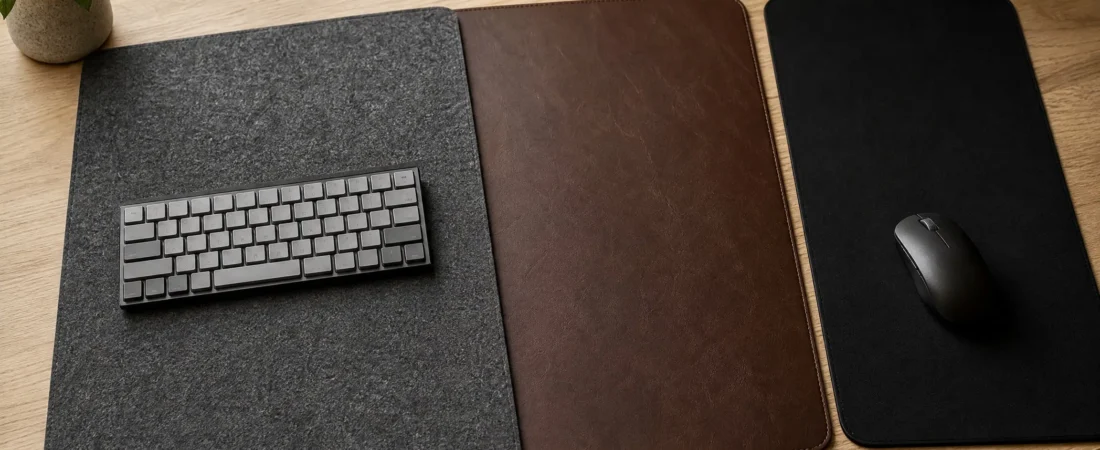
Most people buy a desk mat for one of three reasons: the desk is loud, the desk is getting scratched, or the desk looks bare. Any of the three main materials will solve all three problems. Where they differ is in how they behave after six months, and that is what this guide is about.
The short version
- Felt is the best all-rounder for an office desk. Quiet, warm, hides marks, works with any optical mouse. It collects lint and shows a shiny patch where the mouse lives.
- Leather (real or PU) wipes clean and looks the most formal. It is slightly louder under a keyboard and glossier leathers can confuse cheap optical mice.
- Cloth is what gaming pads are made of. Lowest friction, fastest mouse. It also soaks up spills and holds onto crumbs.
Felt
Pressed wool felt is dense, around 3 mm thick, and has a slightly fuzzy surface. A keyboard on felt is noticeably quieter than a keyboard on bare wood, which is the reason most people keep the mat after the first week. Felt hides coffee rings and pen marks better than anything else on this list.
Two honest downsides. It picks up fibres from your sleeves, so you will use a lint roller now and then. And after a few months there is a smoother, slightly shinier patch where the mouse spends its time. That is felt being felt, not a defect. Our large felt mat is 35 by 17 inches, which covers a full-size keyboard, mouse and a notebook; the compact one suits a 60 to 75 percent keyboard on a smaller desk.
Leather and vegan leather
Leather mats are the ones you see in photos of very tidy desks. They wipe clean with a damp cloth, they do not collect lint, and they read as more formal. PU (vegan) leather behaves the same way at a lower price and without the smell.
The trade-offs: leather is a harder surface, so typing is a little louder than on felt, and a very glossy finish can cause tracking trouble with low-end optical mice. Matte finishes are fine. If you want both worlds, a two-sided mat gives you leather on one face and felt on the other, and you flip it when you change your mind.
Cloth
Cloth mats are thin, usually rubber-backed, and made for mice first. If you play competitive games and care about glide speed, cloth wins and nothing else is close. For a working desk, cloth has the most drawbacks: it absorbs spills, it frays at the edges, and it tends to look tired sooner than the other two.
Sizing
Measure the area you actually use, not the whole desk. Put your keyboard where it lives, put the mouse where your hand rests when you are working, and add about four inches on each side. For most people that lands between 30 and 36 inches wide. If you use a laptop on a stand, the mat only needs to cover the keyboard and mouse in front of it.
What we would pick
For a desk you work at every day, felt. For a desk you want to keep spotless, leather or PU. For gaming, cloth. If you are unsure, start with a compact felt mat; it is the cheapest way to find out whether you like having a mat at all, and it moves easily to a second desk later.
Browse the full range in desk mats, or read the FAQ if you have a question about a specific size.