
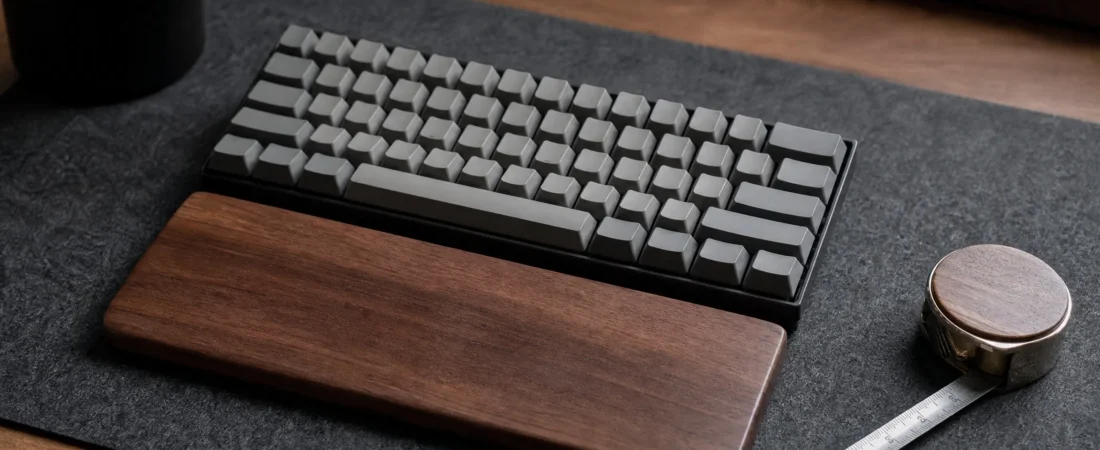
Wrist rests are sold by keyboard layout, but layouts are not standard widths. Two 65% boards from different makers can differ by half an inch. So the reliable way to choose is to measure your keyboard, then pick the rest that is the same length or a touch longer.
Step one: measure the keyboard
Lay a tape measure across the front edge of the keyboard case, from the outside of the left edge to the outside of the right edge. Ignore the keys; the case is what the rest sits in front of. Write the number down in inches or centimetres.
Typical widths by layout
| Layout | Typical case width | Metric |
|---|---|---|
| 60% | 11.5 – 12.0 in | 29 – 30.5 cm |
| 65% | 12.2 – 12.8 in | 31 – 32.5 cm |
| 75% | 12.5 – 13.2 in | 32 – 33.5 cm |
| Tenkeyless (TKL, 80%) | 14.0 – 14.5 in | 35.5 – 37 cm |
| Full-size (100%) | 17.0 – 17.5 in | 43 – 44.5 cm |
These are typical ranges, not guarantees. Aluminium cases and boards with thick bezels run wider than the plastic budget boards of the same layout.
Step two: match the rest
- A rest that is 0 to 0.5 in longer than the case looks intentional and gives your hands room to drift.
- A rest that is shorter than the case leaves one hand hanging off the edge. Avoid it.
- A rest more than 2 in longer than the case starts to get in the way of the mouse.
Which of ours fits what
| Product | Length | Fits |
|---|---|---|
| Memory Foam Wrist Rest, Compact | 12.4 in | 60% and 65% boards |
| Walnut Wrist Rest | 12.6 in | 60%, 65% and most 75% boards |
| Memory Foam Wrist Rest, Full-Size | 17.3 in | TKL and full-size boards |
The TKL case is a compromise. A 17.3-inch rest is about three inches longer than a TKL board, which some people like because it also supports the hand on the mouse side; others find it too much. If that bothers you, the walnut rest is the closest match at 12.6 inches, even though it leaves the arrow cluster uncovered.
Height matters as much as length
The top of the rest should sit level with, or just below, the front row of keycaps with the keyboard feet down. Low-profile boards want a rest around 0.6 inches tall; standard mechanical boards on feet want 0.8 to 1 inch. Our foam rests are 0.8 inches; the walnut rest slopes from 0.6 inches at the front to 0.9 inches at the back, which suits boards with a slight typing angle.
Foam or wood?
Memory foam gives a little and is the safer choice if you rest your wrists heavily while typing. Walnut is firm, cool to the touch, and lasts more or less forever; it suits people who float their hands and only touch down between sentences. There is no wrong answer, and both are covered by our 30-day return policy if you guess wrong.
See all sizes in wrist rests.